
Developer choice matters
A team policy shouldn’t automatically mean one model, one editor, or one way of working.

Why ChronosIQ exists
Developers shouldn’t have to give up model choice to get team support. Engineering leaders shouldn’t have to choose between enabling AI coding and keeping access, spending, and accountability manageable.
We’re building ChronosIQ to bring those needs together.
The problem behind the product
Different models are useful for different tasks. Different developers prefer different tools. But as adoption spreads, teams inherit a fragmented setup: individual accounts, scattered credentials, separate bills, and little clarity about shared usage.
The answer shouldn’t be to force every developer into one model—or make someone administer a growing collection of personal subscriptions.
Teams need a shared foundation for AI coding that preserves developer choice while making the operational side understandable.
The foundation
Today, ChronosIQ provides a gateway and console for accessing supported coding models through compatible tools. Developers can choose a model directly or use automatic routing. Teams can manage access, monitor usage, and work from a shared credit balance.
The goal is practical: help teams adopt AI coding without turning credentials, budgets, and provider integrations into another project to maintain.
The direction
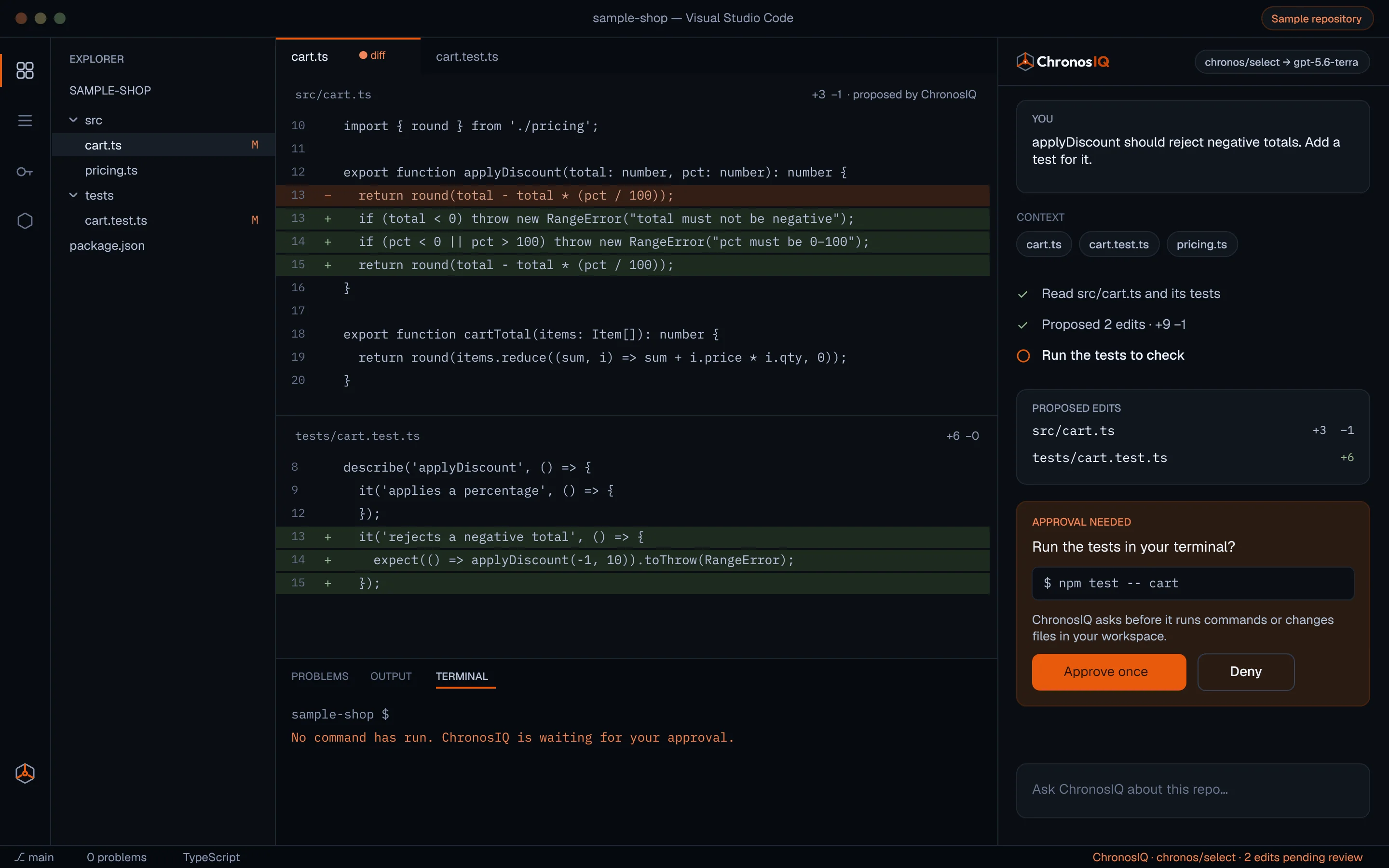
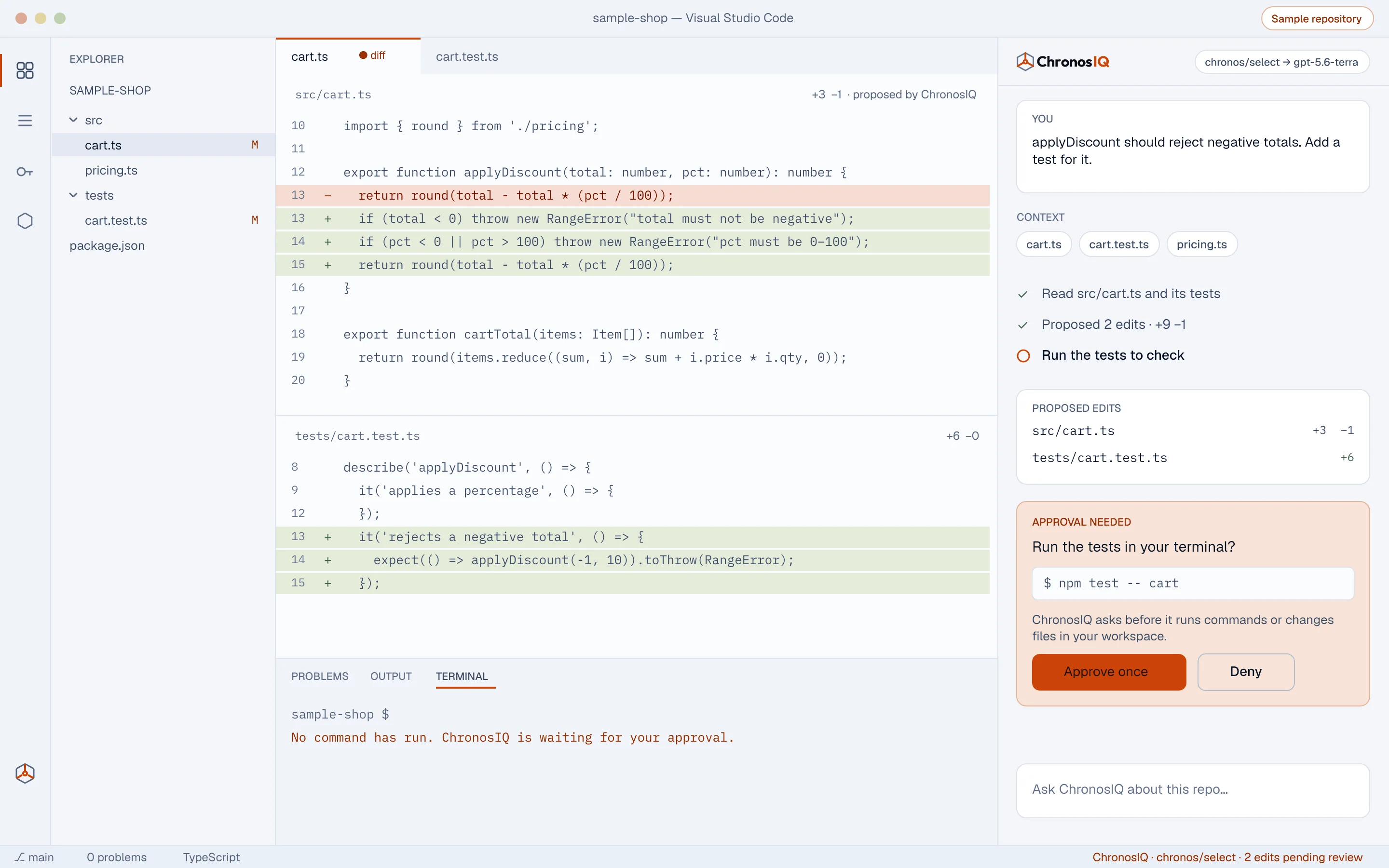
Model access is the foundation—not the whole ambition. We’re developing a ChronosIQ coding experience for VS Code, backed by our own agent runtime.
Our intended direction includes stronger repository navigation and better context handling, so longer tasks can preserve useful information without carrying an ever-growing conversation into every request.
The editor experience is in development. It is not part of the currently available gateway offering.
Product principles
A team policy shouldn’t automatically mean one model, one editor, or one way of working.
People should know what their plan includes, how usage is charged, and what happens at a limit.
Budgets and access policies should help a team use AI responsibly—not make experimentation unnecessarily difficult.
Our developing coding experience is designed around host-controlled permissions for workspace changes and terminal execution.
Compatibility, data handling, and feature availability deserve clear explanations—not broad assurances.
Build with us
We want to understand what remains difficult after the first successful AI demo: the interrupted task, the unclear charge, the context that disappeared, the access someone forgot to revoke. Bring us the real workflow—not just a feature wishlist.
Your next step
Tell us where access, spending, model choice, or context handling gets in your way.
Request early access. Pricing and billing options will be shared before paid access begins. No payment is collected through this form.